The Works of David Alan Berger
MINNESOTA FRINGE 2026 – “A Woman’s Place is in the House” – AUGUST 6-16, 2026
Dave’s new play, “A Woman’s Place is in the House” is a historical yet futuristic comedy featuring the first four women ever elected to the Minnesota State House of Representatives in 1922. Discover the wonderfully clever antics of Mabeth, Myrtle, Sue, and Hannah as they navigate a visit to the future and the past and the present with the all knowing yet know-it-all time traveler, Angela A.
MOST RECENT ARTICLES (archives include articles from 2020-2026)
Minnesotans protest because they feel hopeless
From the column: “They were community members from all walks of life who just wanted peace restored to their neighborhoods.”
By Dave Berger
Today at 1:44 PM, Thursday, January 29, 2026 – Duluth News Tribune
For the last few weeks there have been daily protests at the Bishop Henry Benjamin Whipple Federal Building at Fort Snelling in the Twin Cities. These protests are in opposition to Operation Metro Surge, which U.S. Immigration and Customs Enforcement, or ICE, began in Minnesota on Dec. 1. ICE has described the operation as the largest immigration operation ever, deploying 3,000 agents to the land of 10,000 lakes.
The Whipple federal building is a target for protestors because it is a command center for large-scale ICE immigration-enforcement efforts. It is located within the Unorganized Fort Snelling Territory. Given that it is not located in a city, Hennepin County has jurisdiction for primary policing in the area.
I went to one of the protests at Whipple. As a sociologist, I have studied many political movements over the years and have attended rallies, speeches, sits-ins, protests, marches, party conventions, and other organizing efforts. My goal for attending this most recent protest was to learn more about the people there.
As I approached the main gate, I noticed about a half dozen Hennepin County Sheriff vehicles parked on or near the roadway. There were about 75 protestors there with most having homemade signs. Everyone was bundled up since the windchill was well below zero.
I struck up a conversation with a member of a church group from Minneapolis. She held a sign that read, “Love thy neighbor.” I inquired about what motivated her to be there. She told me it was her first protest ever, but she wanted to do something to help her community. “So many of our church members are afraid to go outside,” she said. “They have seen masked men in unmarked cars randomly detaining and questioning people without cause. They feel they may be next.”
I met a pastor from the same group who said she was there because she feels her congregation and neighborhood are experiencing a very public armed occupation. “I’ve seen ICE agents repeatedly invade whole city blocks without concern for how the average citizen might be affected. They act with complete impunity and little concern for the community.”
Another protestor told me he was there because he saw someone arrested with such incredible violence it reminded him of the George Floyd incident. “They threw the guy to the ground and all jumped on him,” he said. “It’s like they are an army of Derek Chauvins. This time, they want to get us all.”
Others I spoke with echoed that same comparison of Operation Metro Surge to the trauma that affected everyone in Minneapolis during the uprising that followed Floyd’s murder. One person told me, “The helicopters are back, buzzing our neighborhood. We are under attack again.”
That is the same sentiment I sensed when I spoke to others at the protest, that they feel hopeless in the presence of an overpowering armed force that has taken control of their lives. They feel the very fabric of their community is being torn away.
The people I spoke to were peaceful people. The protest I witnessed was also peaceful.
Nowhere did I see evidence for the claim that protestors are dangerous and violent radicals who want to interfere with law enforcement arresting murderers and child rapists. Conversely, they were community members from all walks of life who just wanted peace restored to their neighborhoods.
Who are the protestors and what do they want? They are people who care about others and want to stop unrestrained paramilitary operations in their communities.
Dave Berger of Maple Grove, Minnesota, is a retired sociology professor, freelance writer, author, and regular contributor to the News Tribune Opinion Page.
The Mendota Bridge: Spanning two histories, uniting one people

Mendota Bridge
Posted Saturday, January 3, 2026 10:46 am Nokomis Messenger

David Berger
By David Berger, Howe resident
The Fort Snelling-Mendota Bridge has a long history with many connections to the sacred and hallowed history of Minnesota. In fact, in many ways, it is at the very center of our collective memory, geography, and spirituality. I propose that next year to celebrate the 100th year anniversary of the Mendota bridge that we consider transforming it into a parkway connection with a lower speed limit, green areas, historical markers, and a larger footpath as well as overlooks into the valley.
When the Fort Snelling-Mendota Bridge opened, there were three days of ceremonial activities which culminated in a dignitary filled program on Monday, Nov. 8, 1926. At 2 p.m. on that day a salute of guns from Fort Snelling started a contingent of politicians and officials from Hennepin County marching to the middle of the bridge from the Fort Snelling side as a contingent of politicians and officials from Dakota County began marching to the middle of the bridge from the Mendota side. In the middle they met Minnesota Governor Theodore Christianson who formally opened the bridge by untying golden ropes that had been draped across the center of the span.
When the Mendota bridge was completed 99 years ago, it was the largest concrete arch bridge in the world at 4,119 feet long (just over three-quarter mile). This massive project took two- and one-half years to build, with an average of 200 construction workers working every day throughout that period. Containing 80 thousand yards of concrete, 1,200 tons of steel beams, and eight carloads of bolts, the bridge also has 12 piers that support it at height of 120 feet above the surface of the Minnesota river.
It is fitting that such a monumental structure is dedicated as a memorial to the “Gopher Gunners” 151st Field Artillery of the Minnesota National Guard for their role in World War 1 as part of the U.S. Army’s 42nd Infantry “Rainbow” Division composed of National Guard regiments from many states. The “Gopher Gunners” were a highly decorated unit that played pivotal roles in several key campaigns including the Second Battle of the Marne (July 15-18, 1918). In that battle, several “Gopher Gunners” were killed in action including Pvt. William J. Rubly (Minneapolis); Cpl. Gay E. York (Minneapolis); and Sgt. Harold J. Worrall (Minneapolis).
Each of these three soldiers from Hennepin County also have memorial markers on Victory Memorial Drive in Minneapolis as well as “Rainbow” Division markers at Lakewood Cemetery for the 151st Field Artillery.
The area around the Mendota bridge has historically been a meaningful place. The confluence of the Minnesota and Mississippi rivers holds special significance for many.
To the Dakota people this area is sacred. From Wita Tanka (Pike Island) to Oheyawahe (Pilot Knob Hill) to Mini Owe Sni (Coldwater Spring) all make up Bdote, the sacred area where the two rivers meet the sky and where the Dakota were created. For hundreds of years this area has been important for trade, social interaction, and burials.
When pioneers first settled Minnesota, Bdote was a central place for trade, treaties, and worship. As the oldest continually used church in Minnesota, the Church of St Peter (built in 1853) sits on the river bluff just a stone’s throw from the Mendota Bridge. It’s historic cemetery in Mendota was founded in 1840.
Since the Mendota Bridge construction began in 1924, the area near it has increased its number of sacred monuments including three major cemeteries. In 1925, Acacia Park Cemetery was created by the Masonic order on Pilot Knob Hill in Mendota Heights and officially opened in 1928. In 1939, the Fort Snelling National Cemetery was dedicated and now has well over 260,000 interments including the grave of Colonel George Emerson Leach, commander of the “Gopher Gunners” during WWI and former mayor of Minneapolis. In 1941, Resurrection Cemetery was opened also in Mendota Heights by the Catholic Cemeteries.
The Mendota bridge spans the Minnesota River just feet from where it meets the Mississippi River where waters from Lake Itasca 235 miles away mingle with waters from Big Stone Lake near the border with South Dakota that have traveled over 330 miles. Ecologically, this area is the citadel of the flowing waterways of Minnesota; spiritually it is sacred as well.
I have walked and run across the bridge many times. You can feel the sacred nature of the bridge and its vistas when you cross it. You can see everything from this one spot: the Minnesota river valley; the skyline of downtown Minneapolis; the Skyline of downtown St Paul, Wita Tanka; Oheyawahe; and Mini Owe Sni; Fort Snelling, the airport, the Cathedral of St. Paul, and even the Sperry Tower in Eagan.
The Fort Snelling-Mendota Bridge is a spectacular construction with an immensely important history. Unfortunately, we are under utilizing the possibilities of making it a sacred place of beauty and awe. By converting it into a more accessible and usable parkway connection, we can give it an honorable place in our community. Conversely and sadly we can let it remain just another loud highway bridge.
Dave Berger of Maple Grove, Minn., is a retired sociology professor, freelance writer, and author.
Local View: On its 182nd anniversary, celebrate ‘A Christmas Carol’
From the column: “It was the pairing of Leech’s pictures with Dickens’ passages that made this book an overnight success, with the entire first printing of 6,000 copies sold in just one week.”
By Dave Berger
December 15, 2025 at 9:05 AM
On Tuesday, Dec. 19, 1843, in London, 31-year-old Charles John Huffam Dickens published “A Christmas Carol.” A ghost story of Christmas, it is indisputably his most popular book. At only 166 pages, the holiday novella contains eight splendid illustrations created by Dickens’ lifelong friend John Leech, then just 26 years old. Each depiction is indispensable in bringing to life (and death) the iconic characters created by a brilliant author.
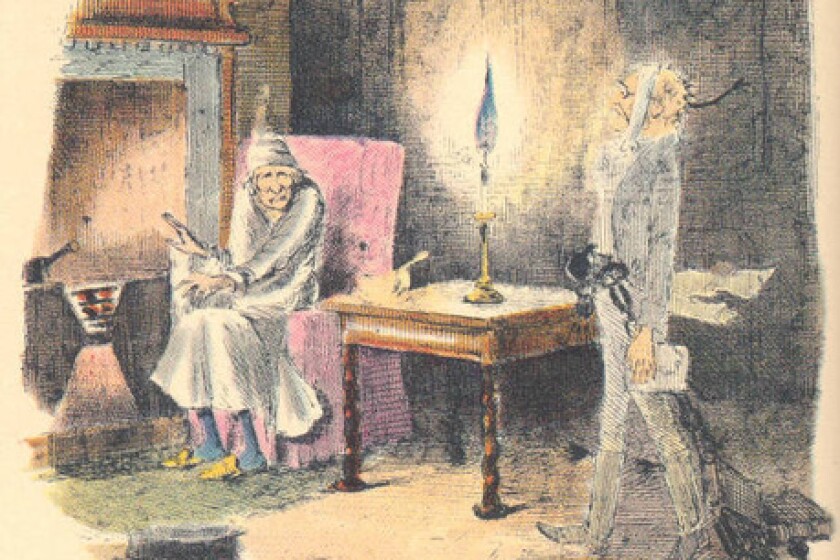
The first picture is “Marley’s Ghost.” It depicts the crotchety old miser Ebenezer Scrooge in his bedgown and cap, reminiscent of one worn by a dunce, being confronted by his former partner in life and business, Jacob Marley. It is at this point that Scrooge learns of the doom that awaits him if he does not change his ways.
This hand-colored steel engraving contextualizes the entire plot to come, complete with the now-classic long chain wrapped about Marley, symbolizing what he forged in life.
The next illustration, “The Ghosts of Departed Usurers, or, The Phantoms,” showed the ghosts of loan sharks who can do nothing to help a poor woman and her suffering, a plight destined for Scrooge because of his unkind ways. This black-and-white wood engraving is particularly jarring because it portrays perfectly the agony of both the woman and the specters.
In contrast to the first two drawings, the third depicts a most merry Christmas as Scrooge’s former employer puts on a dance for his workers. This delightfully colorful depiction, “Mr. Fezziwig’s Ball,” sends the message that both rich and poor can celebrate the holiday together in mutual comfort and joy. As Dickens notes, “The Good Old Times with the Good Old Employer at Christmas.”
It is in the fourth illustration, “Scrooge Extinguishes the First of the Three Spirits,” when the reader encounters heavily Scrooge’s rejection of the attempt to reform him. Here, he is depicted using a candle extinguisher to rid himself of the first spirit. His actions are in vain since the light cannot be put out due to its incredible luminosity.
The fifth picture, “The Second of the Three Spirits,” is my absolute favorite, as it depicts the hearty good soul of the Ghost of Christmas Present. With abundant food and light emitting from a torch and a blazing fireplace, the reader is brought back to the possibilities of a lovely Christmas for all.
Of course, this sets us up for a great fall when illustration six, “Ignorance and Want,” has this kind spirit reveal the dark side of Christmas. The two street urchins, ignorance and want, are depicted as being in the most terrible condition, with huge factories in the background showing the costs of industrialization and capitalism. Scrooge becomes genuinely concerned as the picture shows his hand pointing to the youth as if to ask what can be done to help them.
This leads to the spirit reminding the miser of his comment, “Are there no prisons? Are there no workhouses?”
At this point, Scrooge is prepared for the third spirit. The seventh picture, “The Last of the Spirits — The Pointing Finger,” introduces us to the most frightening of all the ghosts. Dressed like death, this specter says nothing but points to Scrooge’s grave with the most ominous of gestures. This darkest depiction makes Scrooge seek redemption without hesitation.
It is with the last illustration, “Scrooge and Bob Cratchit, or, The Christmas Bowl,” that the reader and the world are invited to partake in the reformation of Ebenezer and the uplifting of Bob and his family, including his beloved son Tiny Tim. This wood-block engraving is simple and portrays the boss and worker becoming friends over a Christmas punch and a warming bright fireplace.
I contend it was the pairing of Leech’s pictures with Dickens’ passages that made this book an overnight success, with the entire first printing of 6,000 copies sold in just one week.
It is fitting at this time of year that we celebrate both Dickens and Leech for their most illustrious contribution to the Christmas season.
As Scrooge exclaimed after his salvation, “A merry Christmas to everybody! A happy New Year to all the world!”
Dave Berger of Maple Grove, Minnesota, is a retired sociology professor, freelance writer, author, and regular contributor to the News Tribune Opinion Page.
Local View: Duluth’s Roussain Cemetery remains at the crossroads of cultures
From the column: “At one time (it) contained spirit houses, headstones, crosses, an obelisk, a white picket fence, and room for people from a variety of ethnic backgrounds and traditions.”
By Dave Berger
September 11, 2025 at 3:26 PM
In the 1980s, I was a teaching assistant at the University of Minnesota in the Twin Cities for several professors in the Department of Sociology. One of my favorite faculty to work with was Dr. Robert Fulton.
Bob was an amazing scholar in the study of death and dying, also known as thanatology. He taught the first college-level course in the United States on that subject in 1963. He also founded the Center for Death Education and Research in 1969.
When I worked with him, he would introduce himself to the students as one of the top three experts on death. “Yes, there is God and the devil and then me — not necessarily in that order,” he’d say. He had a delightful, yet quite macabre, sense of humor.
Bob’s gift to me was an immense appreciation of thanatology. During my academic career, I have done a great deal of teaching and research in this field. I believe that how we interact with death signifies a great deal about the meaning we attach to our collective lives.
This summer, I spent some time in Roussain Cemetery , which is peacefully nestled in the middle of Mission Creek Park in Duluth’s far-western Fond du Lac (Foot of the Lake) neighborhood. The Superior Hiking Trail and Mission Creek Parkway border closely to this sacred and solemn land. Walking through these woods as I approached the graveyard, I experienced the astonishing beauty of the land yet also sensed the collective presence of the vast variety of souls that had lived, worked, breathed, and died there.
This burial ground was created by Francios Roussain, Sr. in 1870 on his land because the construction of the Lake Superior & Mississippi Railroad (which was financed by Jay Cooke) cut through the old Fond du Lac cemetery (behind the trading post), unearthing the remains of many, including Ojibwe, French, Canadians, and others. Francios offered his land for the reburial of these unfortunate people. He decided to have the land consecrated as a Christian cemetery.
The cemetery itself is quite small, with its metal wire fencing making a square of no more than 4,000 square feet. Within this small plot are buried many notable people of this area during the 19th century, including Francios Tagosh “ Frank” Roussain, Sr.(1815-1885); his spouse Susan Zowedah “Zoe” Cadotte Roussain (1827-1902); all five of their children, including John Roussain(1836-1843), Leassie Roussain (1845-1847), and Francios “Frank” Roussain, Jr. (1838-1900); Celia Roussain Durfee (1836-1918); and Eustche Edgar Roussain (1839-1912). Their close family friend, Vincent S. Roy, Sr. (1795-1872) is also buried in the cemetery.
Francois Roussain, Sr. oversaw the American Fur Company trading post at Fond du Lac during and after Minnesota became a state, from 1840 to 1860. The remnant foundation of his home now houses a garden on private land near 133rd Avenue West and West Second Street (across the street from the historical park). Francios was both Ojibwe and French Canadian while his wife Zowedah was Ojibwe. His friend Vincent S. Roy, Sr. was also of French Canadian and Ojibwe descent and a successful fur trader.
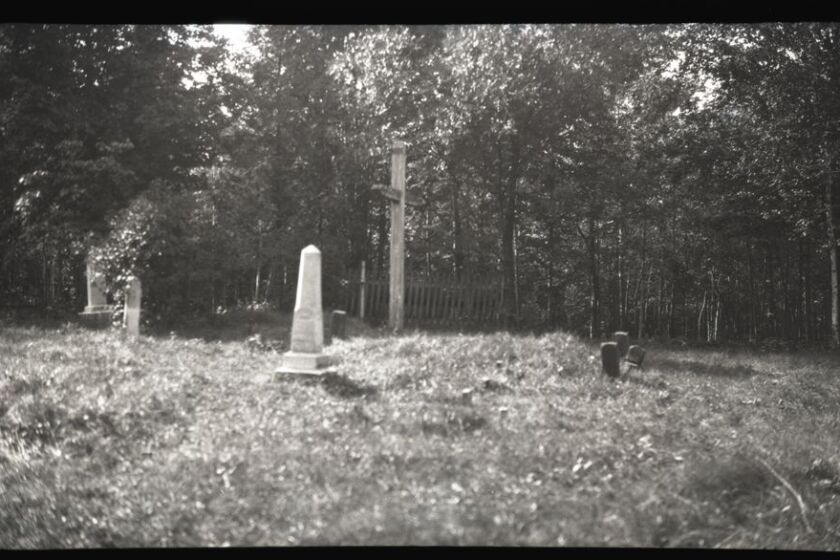
According to multiple historical records, including several articles in the News Tribune, Roussain is a truly blended cemetery that, at one time, contained spirit houses, headstones, crosses, an obelisk, a white picket fence, and room for people from a variety of ethnic backgrounds and traditions. Over the years, many of these symbols have disappeared or receded back into the earth. Two remaining headstones — one shared by John Roussain and his sister Leassie and the other for Vincent Roy, Sr. — have toppled over and now resemble footstones.
By 2004, it was decided by the Duluth City Council to grant guardianship of the cemetery to the Fond du Lac Reservation (Nagaajiwanaang) by granting it a 99-year lease. On one of my visits to the cemetery this summer, Curtis and April from Nagaajiwanaang came to mow around the cemetery, straighten the fence, remove weeds, and otherwise landscape the area.
I spoke with them about the cemetery. They both understood the spiritual significance to maintaining the site. Nagaajiwanaang has rightfully embraced the stewardship of this sacred land.
Dave Berger of Maple Grove, Minnesota, is a retired sociology professor, thanatologist, freelance writer, author, and regular contributor to the New Tribune Opinion Page.
Local View: Politics can heighten anxiety; our imaginations can run it rampant
From the column: “I imagine a world where everyone with a mental health issue gets the help they need.”

By Dave Berger
March 03, 2025 at 1:58 PM
“Hold your breath, make a wish, count to three. Come with me, and you’ll be — in a world of pure imagination. Take a look, and you’ll see — into your imagination.“
Leslie Bricusse and Anthony Newly wrote that song, “Pure Imagination,” for the 1971 children’s classic, “Willy Wonka & and the Chocolate Factory,” starring Gene Wilder. Wilder first sings this song after the five lucky children who found golden tickets are invited to tour the mysterious candy factory, led by a mysterious candymaker in an equally mysterious town never mentioned in the film (the real setting was Bavaria, Germany, including Munich).
As they approach a very small door, Wonka states the room behind the door contains the nerve center of the entire factory, where “all of my dreams become realities and some of my realities become dreams.” After unlocking the very small door with a musical combination (Mozart’s “Overture to the Marriage of Figaro” and not Rachmaninoff, as misattributed by Mrs. TeeVee), he opens it, and it turns into a giant door on a different level that reveals the Chocolate Room, an almost endlessly enormous space full of the most wonderfully oversized treats. Everything is made of delicious candy, like teddy bear-sized gummies, candy-cane trees, gumballs, licorice, and even a river of pure chocolate with its own waterfall. It’s a world where everything is yummy, edible, and beautiful.
There is something very calming about Wonka’s first words as they enter the Chocolate Room: “Hold your breath, make a wish, count to three.” This reminds me of mindfulness-grounding exercises like 5-4-3-2-1 or yoga breathing techniques that reduce anxiety by placing you in the moment — in this case, the reality of the Chocolate Room.
Of course, such a place does not exist except in the film, with cardboard and props, so Wonka invites us to go further and look into our own imaginations. On the surface this sounds lovely and calming, but it can also be a very frightening place with terrible, anxiety-filled moments, like when poor Augustus Gloop falls into the chocolate river and gets sucked into a chocolate pipe, not to be seen the rest of the film but noted that he will be fine and a bit wiser.
These imagined dreadful things are not real. All of this is just a fantasy film based upon the imagination of Roald Dahl. No one was hurt in the filming, and I can imagine many of the actors had fun with the sets and each other. Maybe there was even a food fight.
I have struggled most of my life with anxiety. Because of the heightened anxiety of a recent surgery and the current social, political, and economic environment in our nation, I am currently getting professional help. I am far from alone. The National Alliance on Mental Illness estimates that nearly one in five adults in the U.S. has an anxiety disorder. And the National Library of Medicine determined that a significant number of college students have trauma and distress related to November’s presidential election.
While politics and other stressors can overwhelm our imaginations, known as anticipatory anxiety, there is assistance to help turn our imaginations to a calming and balanced place. With guidance from wonderful professionals — including primary-care physicians, physiatrists, therapists, social workers, and support groups — programs, and useful medicines, we can help train our imaginations to work for our calmness.
Writing this commentary was difficult for me. But then I realized it was my anxiety, something I imagined, that I can equally unimagine, with support.
Those living with heightened anxiety because of our politics can reduce their distress by getting help. Joining a support group might be one of the best options.
Living in the moment, I can know that I am safe, loved, cared for, and enough. I can remember that whatever I am dealing with is temporary, and I can get the help that I want and need.
If you are suffering from anxiety, you can get the help you need, too. I imagine a world where everyone with a mental health issue gets the help they need. We can all work to make this happen.
Dave Berger of Maple Grove, Minnesota, is a retired sociology professor, freelance writer, author, and regular contributor to the News Tribune Opinion page.
Pronouns are always personal, never political
From the column: “When I do feel comfortable sharing my pronouns, I will do so, despite any heavy-handed government regulation.”

by Dave Berger
Today at 11:00 AM- Duluth News Tribune
I am beginning to really dislike pronouns. More accurately, I dislike how people are making the use or non-use of pronouns a toxically political way to divide our country. These extremists on both sides of the “pronoun issue” are equally responsible for the mess in which we now find ourselves.
For years, there have been institutions and companies requiring their members when they communicate with others to state their preferred pronouns. They really don’t give their people a choice. They believe this is a necessary edict so people can feel free to identify with the pronoun that makes them most comfortable. This thinking is wrongheaded and defeats the very reason they claim that pronouns must be announced to the world: to make people feel better and more welcome.
A person’s choice of pronouns for themselves is a very deeply personal and private decision. They should not be required to release such personal information unless they wish to. Maybe some reserve such information for close friends. This pronoun exposure is a form of “outing” that is completely unnecessary.
Some entities that require their members to share their preferred pronoun say it is voluntary. Of course, in the form of memos, emails, and verbal communications they “highly recommend” that you follow this edict. Most members of an organization do not feel comfortable going against the culture of their group. So, in essence, they are making the release of private information mandatory in the name of freedom of choice and equality.
What a horrific contradiction.
Equally idiotic are those institutions today, both public and private, that prohibit sharing our pronouns in our communications. This, too, is a direct attack on our personal freedoms. If someone wants to end or begin a conversation or an email with their preferred pronouns, that should be their individual personal choice. A mandatory ban on pronouns violates our freedom of speech, expression, and identity. It is a step toward state-controlled speech. Only allowing acceptable ways of communicating that are approved by the government sounds like something out of George Orwell’s “1984”: “Big Brother is watching you.” So much for small, unintrusive government.
Both extremist groups have taken pronouns that are personal and have made them political.
I have a close friend whose name is difficult to pronounce or even write correctly. That person’s name is “B.” B goes by B because B feels more comfortable not releasing B’s private and personal pronouns. But, sometimes, for clarity of communication, B chooses to share B’s pronouns. That is absolutely B’s freedom of speech and choice to share B’s preferred pronouns. The pronoun extremists world force B either to reveal B’s personal and private pronouns or force B to keep B’s pronouns a secret even if B wants to share B’s identity.
These ideologies disregard the very democratic and constitutionally guaranteed rights we all have. It is a disgrace to make something so personal in any way required or banned.When I am now asked by folks what my preferred personal pronouns are, I say I am very uncomfortable sharing that with people until I get to know them. Just call me Dave or, better yet, just D. When I do feel comfortable sharing my pronouns, I will do so, despite any heavy-handed government regulation.
It would be better for the entire nation if we stop making pronouns a political litmus test one way or the other. Let B be B.
Dave Berger, or D, of Maple Grove, Minnesota, is a retired sociology professor, freelance writer, author, and regular contributor to the News Tribune Opinion page.
Formulaic romcoms can actually be amazingly surprising
From the column: “The next time you are thinking about seeing a romcom and dismiss it out-of-hand as boring or predictable, look a little deeper.”
Bill Murray stars in the 1993 film, “Groundhog Day.”
(Columbia Pictures)
by Dave Berger
Today at 1:08 PM – Monday, April 7, 2025
Most people hear ”romantic comedy,” or “romcom,” and picture a formula-based story involving a love triangle, a false-identity plot, a mortal-enemies-who-become-lovers twist, and/or the best-friends-to-lovers retread — almost always with the couple living happily ever after. Many of the films of this genre are written paint-by-numbers style to produce films that audiences roll their eyes at as they continually whisper to each other about what will predictably happen next.
Thankfully, there are some unique romcoms that utilize four enticing themes to create outstanding films that are engaging and unexpectedly refreshing.
The first theme of time travel is used in terrific films like “Groundhog Day” (1993), “Kate and Leopold” (2001), “Midnight in Paris” (2011), and “About Time” (2013). While each is very well written and integrates the time element masterfully, “About Time” is my favorite because Tim (played by Domhnall Gleeson) is a time traveler who realizes his love for Mary (Rachel McAdams) transcends his ability to move through time. He discovers that everyday authentic love, with its ups and downs, is better than trying to manipulate the timeline to create the perfect relationship. Of course, it takes him time to get there, so the audience is treated to his hilarious attempts to bumble around time, a lot like Phil (Bill Murray) in “Groundhog Day.”
A second theme used in romcoms is daring to defy the often-used ending, “and together they lived happily ever after.” While “Goodbye Mr. Chips” (1939), “Roman Holiday” (1953), and “Shakespeare in Love” (1998) each do well with the non-together ending, I believe “Goodbye Mr. Chips” is the most heartfelt of these non-traditional films. Mr. Chips (Robert Donat) is a teacher who finds his true place in life only after meeting and falling deeply in love with his wife Katherine (Greer Garson). Paraphrasing a line from “Jerry Maguire” (1996), “She completed him” and his life’s work before she sadly passed away during childbirth.
A third theme involves a focus on the families of the couple in love and their different cultures. Films such as “My Big Fat Greek Wedding” (2002), “Today’s Special” (2009), and “Our Family Wedding” (2010) are about much more than romance. They highlight hilarious differences in how people live their lives. My favorite is “My Big Fat Greek Wedding.” I will never forget the scene when the two families meet for the first time and the visiting family brings a bundt cake that ends up being a planter of sorts for the other family.
Perhaps the most interesting and rarest romcom theme element is the couple in love not kissing during the film. Two notable films in this category are “Sleepless in Seattle” (1993) and “High School Musical” (2006). “Sleepless in Seattle” takes the non-physical romantic comedy to new heights, since Sam Baldwin (Tom Hanks) and Annie Reed (Meg Ryan) live in opposite sides of the country and only share two scenes in the entire film. In fact, remarkably, during the one hour and 45-minute film, they share less than three minutes of screentime.
So, the next time you are thinking about seeing a romcom and dismiss it out-of-hand as boring or predictable, look a little deeper. You might be missing a film that breaks the mold and aspires to amazingly surprise and engage its audience in unforeseeable ways.
Paraphrasing from “Notting Hill” (1999), “I’m just a romcom, standing in front of a moviegoer, asking them to love me.”
Dave Berger of Maple Grove, Minnesota, is a retired sociology professor, freelance writer, author, and regular contributor to the News Tribune Opinion page.
Hey everyone…
“Politics can heighten anxiety: our imagination can run it rampant”
Here is the most recent article I wrote. It was just published in the Duluth News Tribune On March 4, 2025, but it might be behind a pay wall….so I copied and pasted it below for you.
Warning if you are dealing with high anxiety right now, you may not want to read this article because it deals with anxiety. By the way, The National Institute of Mental Health has a great help page if you are experiencing a mental health crisis…..https://www.nimh.nih.gov/health/find-help
Politics can heighten anxiety; our imaginations can run it rampant
From the column: “I imagine a world where everyone with a mental health issue gets the help they need.”Politics can heighten anxiety; our imaginations can run it rampant

by Dave Berger
March 4, 2025
“Hold your breath, make a wish, count to three. Come with me, and you’ll be — in a world of pure imagination. Take a look, and you’ll see — into your imagination.“
Leslie Bricusse and Anthony Newly wrote that song, “Pure Imagination,” for the 1971 children’s classic, “Willy Wonka & and the Chocolate Factory,” starring Gene Wilder. Wilder first sings this song after the five lucky children who found golden tickets are invited to tour the mysterious candy factory, led by a mysterious candymaker in an equally mysterious town never mentioned in the film (the real setting was Bavaria, Germany, including Munich).
As they approach a very small door, Wonka states the room behind the door contains the nerve center of the entire factory, where “all of my dreams become realities and some of my realities become dreams.” After unlocking the very small door with a musical combination (Mozart’s “Overture to the Marriage of Figaro” and not Rachmaninoff, as misattributed by Mrs. TeeVee), he opens it, and it turns into a giant door on a different level that reveals the Chocolate Room, an almost endlessly enormous space full of the most wonderfully oversized treats. Everything is made of delicious candy, like teddy bear-sized gummies, candy-cane trees, gumballs, licorice, and even a river of pure chocolate with its own waterfall. It’s a world where everything is yummy, edible, and beautiful.
There is something very calming about Wonka’s first words as they enter the Chocolate Room: “Hold your breath, make a wish, count to three.” This reminds me of mindfulness-grounding exercises like 5-4-3-2-1 or yoga breathing techniques that reduce anxiety by placing you in the moment — in this case, the reality of the Chocolate Room.
Of course, such a place does not exist except in the film, with cardboard and props, so Wonka invites us to go further and look into our own imaginations. On the surface this sounds lovely and calming, but it can also be a very frightening place with terrible, anxiety-filled moments, like when poor Augustus Gloop falls into the chocolate river and gets sucked into a chocolate pipe, not to be seen the rest of the film but noted that he will be fine and a bit wiser.
These imagined dreadful things are not real. All of this is just a fantasy film based upon the imagination of Roald Dahl. No one was hurt in the filming, and I can imagine many of the actors had fun with the sets and each other. Maybe there was even a food fight.
I have struggled most of my life with anxiety. Because of the heightened anxiety of a recent surgery and the current social, political, and economic environment in our nation, I am currently getting professional help. I am far from alone. The National Alliance on Mental Illness estimates that nearly one in five adults in the U.S. has an anxiety disorder. And the National Library of Medicine determined that a significant number of college students have trauma and distress related to November’s presidential election.
While politics and other stressors can overwhelm our imaginations, known as anticipatory anxiety, there is assistance to help turn our imaginations to a calming and balanced place. With guidance from wonderful professionals — including primary-care physicians, physiatrists, therapists, social workers, and support groups — programs, and useful medicines, we can help train our imaginations to work for our calmness.
Writing this commentary was difficult for me. But then I realized it was my anxiety, something I imagined, that I can equally unimagine, with support.
Those living with heightened anxiety because of our politics can reduce their distress by getting help. Joining a support group might be one of the best options.
Living in the moment, I can know that I am safe, loved, cared for, and enough. I can remember that whatever I am dealing with is temporary, and I can get the help that I want and need.
If you are suffering from anxiety, you can get the help you need, too. I imagine a world where everyone with a mental health issue gets the help they need. We can all work to make this happen.
Dave Berger of Maple Grove, Minnesota, is a retired sociology professor, freelance writer, author, and regular contributor to the News Tribune Opinion page.
Dave Berger
Last year’s election bolstered ‘glory of womankind’ in our nation
From the column: “Too many folks have become cynical about our polarized political landscape, but progress is still being made nationwide when it comes to equal rights.”

Opinion byDave Berger
Duluth News Tribune
Thursday, January 16, 2025 at 1:22 PM
Just a bit more than a century ago, on Monday, Jan. 5, 1925, at noon in Cheyenne, Wyoming, Nellie Tayloe Ross was sworn in as the first woman governor of a U.S. state. That same month, a ceremony was held at noon in Austin, Texas, on Tuesday, Jan. 20, to swear in Miriam A. Ferguson, the second woman governor of a U.S. state.
Amazingly, a nation that did not have any female governors during its first almost 150 years suddenly had two.
This exciting moment for equal rights, a century ago this month, was noted, including by Mary C.C. Bradford, Colorado’s state superintendent of public instruction. She sent a telegram to Gov. Ross, reading, according to the front page of the Casper, Wyoming, Star Tribune on Jan. 6, 1925, “Congratulations to the first woman governor from the state which first elected women to state office. May all your plans and programs become splendid realities, making for the honor of your state and the glory of womankind.”
This same sense of historical elation was expressed in the large headline on the top of the front page of the Waco Times-Herald, noting on Jan. 20, 1925, the swearing in of Gov. Ferguson. That headline read: “Humble and Mighty See Housewife Become Governor: ‘Ma’ Ferguson Takes Oath in Wild Tumult.”
I can only imagine the sense of euphoria of many at that time who had fought so hard for women’s suffrage and equity.
Unfortunately, this quick start to female representation in the ranks of American governors slowed to a trickle during the next 50 years. While Gov. Ferguson was reelected to a second term in 1933, it was not until 1967 that the United States had its third woman governor, when Lurleen Wallace, wife of Gov. George Wallace, was elected in Alabama. All three of the women who served as governors from 1925 to 1974 were the wives or widows of a previous governor and had limited political experience.
This all changed on Wednesday, Jan. 8, 1975, when Ella T. Grasso was sworn in as the 83rd governor of Connecticut. Unlike Ross, Ferguson, and Wallace, Gov. Grasso had a very successful political career of her own before being elected governor. The editorial board of the Naugatuck (Connecticut) Daily News noted her outstanding career on January 9, 1975, writing, “We freely acknowledge that Ella Grasso has proven herself as a state legislator, a state executive, and a U.S. representative. Regardless of political persuasion, no thinking person can deny that the lady has ability.”
Gov. Grasso’s election was just the beginning of numerous women governors with extensive and thriving political careers. From 1975 to 2025, 46 more women became governors of U.S. states. In all, 32 states have now had a woman as governor. Arizona leads the way with five women governors, while New Hampshire is close behind with four.
The election of 2024 set yet another new record for women governors in the United States. When the people of New Hampshire elected former state Attorney General and U.S. Sen. Kelly Ayotte to be their governor on Nov. 5, they guaranteed that 13 women will be governors in our states simultaneously this year, a new record.
Too many folks have become cynical about our polarized political landscape, but progress is still being made nationwide when it comes to equal rights. That includes the expanded opportunities in the governorships of our country.
The telegram from Mary C.C. Bradford to Gov. Ross in 1925 echoes back to us today through the halls of history. All 13 of our women American governors in 2025 have plans and programs that will hopefully honor their respective states, the glory of womankind, and all of us.
Dave Berger of Maple Grove, Minnesota, is a retired sociology professor, a freelance writer, and author, and a regular contributor to the News Tribune Opinion page.

Dave Berger
A tale of two taverns — and what it reveals about our politics
The worldviews of Trump and Harris supporters can be found inside a pair of Minnesota pubs.

An interior image of the Buckman Bank Tavern in Buckman, Minnesota. Credit: Photo by Dave Berger
by Dave Berger MinnPost January 7, 2025…. A rewrite from the previous article for the Duluth News Tribune from December
It’s been over two months since the 2024 presidential election, and many are still taking stock of the results. Clearly, we remain a divided nation. While Donald Trump convincingly defeated Kamala Harris in the electoral college 312 to 226, the popular vote was much closer with 49.9% for Trump and 48.4% for Harris, a margin of just 1.5 percentage points.
Examining the election results on the Minnesota Secretary of State website, it is easy to discover the location of the most Trump-supporting community and the most Harris-supporting community within Minnesota. Comparing these two areas might shed some light on why we differ so much in our presidential politics.
Statewide, three of the precincts that voted the most for Trump are in Morrison County just east of Little Falls, along Minnesota Highway 25. Buckman Township, Buh Township and Pierz Township voted an average of 91.55% for Trump with an average of only 7.05% voting for Harris.
The small working-class town of Buckman, population 312, is at the center of Trump country. According to U.S. Census data, the median annual household income in this area is $82,500 with a median home value of $212,585. About 9.5% of people there live below the poverty level. Additionally, while 92.3% of the town’s residents are high school graduates, 23.8% of the people have a bachelor’s degree or higher.
Visiting folks there, I found them very friendly and open. In particular, the people at the family-owned Buckman Bank Tavern were quite insightful and amiable.
The tavern is housed in the old Buckman State Bank Building that was built in 1917. It still contains the original bank vault. In fact, the owners have painted the front door to look just like the bank vault door.
The tavern is a charming place with a myriad of neon signs, flags and other sports and beverage-related decorations. In many ways, it is exactly what is imagined when you think of a classic traditional, no-frills bar complete with comfortable high back stools, pool, dart leagues and pull tabs.
There are two flags on the tavern walls that signal the political leanings of the community. Toward the back is a red, white and blue “Trump–2024–Make America Great Again!” flag and near the front is a flag with a photo of Gov. Tim Walz on it wearing a dunce cap with the message, “My governor is an idiot.”
Statewide, three of the precincts that voted the most for Kamala Harris are in Hennepin County in Minneapolis just east and south of Lake Harriet. These precincts voted an average of 91.33% for Harris with an average of only 6.42% voting for Trump. They are in the neighborhoods of Lynnhurst, King Field and East Harriet.
The bustling upper middle-class neighborhood of Lynnhurst, population 5,691, is at the center of Harris country. According to Census data, the median annual household income in this area is $177,490 with a median home value of $651,372. About 3.3% of the people there live below the poverty level. Additionally, while 94.1% of the people in the neighborhood are high school graduates, 65.1% of the people have a bachelor’s degree or higher.
Visiting folks there, I found them very friendly and open. In particular, the people at the family-owned George and the Dragon Public House were quite insightful and amiable.
The pub is housed in a building built in 2010 and contains Patina, a high-end gift shop, and the refined chic French bistro Saint Genevieve.
The pub is a charming place with lots of soft wood tones, appealing colors and delicate lighting. The walls look like an art gallery with lovely paintings done by a local artist. In many ways, it is exactly what is imagined when you think of an eloquent restaurant complete with chef, maître d’ and boutique bar that sells wine and craft beers.
There are two signs in the front window of the pub that signal the political leanings of the community. One sign has a picture of four diverse young people with one wearing a shirt that reads “# I Can’t Breathe” and a larger caption: “No Justice, No Peace.” The other sign has the symbol and name for “World Central Kitchen,” which indicates George and the Dragon has partnered with WCK to provide meals to those in need in the Twin Cities.
The Buckman Bank Tavern and George and the Dragon Pub, just 95 miles apart, are mirror images of their respective communities. Folks in Buckman are more definitive in that choices should be straight forward, traditional and plainly understood while the folks in Lynnhurst see more shades of gray with evolving and multiple definitions possible. The two restrooms at the tavern, for example, are labelled “men” and “women” while the two restrooms at the pub are labelled “unisex.”
Furthermore, the cuisines of these respective localities sum up their basic differences. The tavern with simple comfort food like chicken strips and mini corndogs shows a desire for simple and clear politics without ambiguity while the intricate Chicken Milanese and Steak Au Poivre of the pub shows a desire for diverse, complicated and involved political perspectives.
The menus reflect the mentalities of these two subcultures.
Dave Berger, of Maple Grove, is a retired sociology professor, freelance writer and author.
Minnesota strongholds for Harris, Trump not far apart — geographically
From the column: “The Buckman Bank Tavern and the George and the Dragon Pub, just 95 miles apart, are mirror images of their respective communities.”
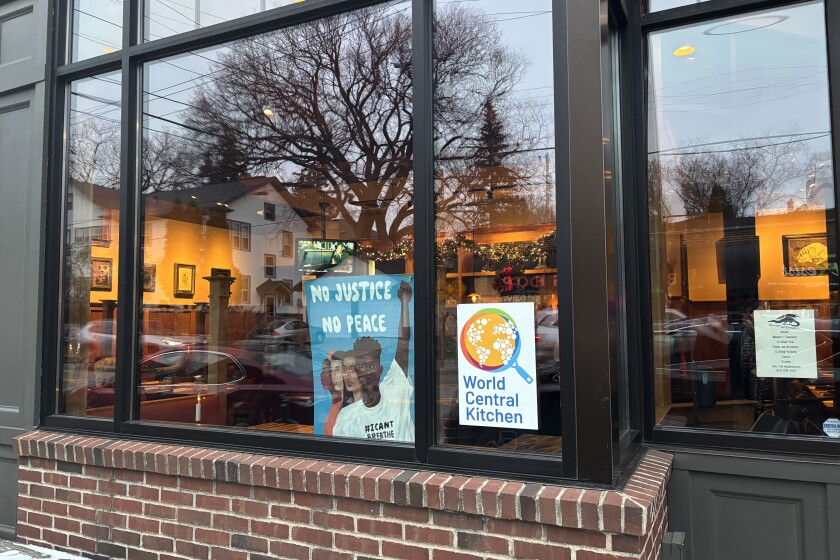
The George and the Dragon Public House is in the heart of Minnesota Harris country, in Lynnhurst, Minnesota.
(Contributed photo by Dave Berger)
Opinion by Dave Berger
Duluth News Tribune, Wednesday, December 18, 2024
It’s been over a month since the 2024 presidential election, and many are still taking stock of the results. Clearly, we remain a divided nation. While former President Donald Trump convincingly defeated Vice President Kamala Harris in the Electoral College 312 to 226, the popular vote was much closer with 49.9% for Trump and 48.4% for Harris, a margin of just 1.5 percentage points.
By examining the election results on the Minnesota Secretary of State website, it is easy to discover the locations of support for Trump and the places that supported Harris within Minnesota. Comparing these two areas might shed some light on why we differ so much in our presidential politics.
Statewide, three of the precincts voting the most for Trump were in Morrison County just east of Little Falls, along Minnesota Highway 25. Buckman Township, Buh Township, and Pierz Township voted an average of 91.55% for Trump with an average of only 7.05% voting for Harris.
The small, working-class town of Buckman, population 312, is at the center of Minnesota Trump country. Visiting folks there, I found them very friendly and open. In particular, the people at the family-owned Buckman Bank Tavern were quite insightful and amiable.

The Buckman Bank Tavern is in the heart of Minnesota Trump country, in Buckman, Minnesota.
(Contributed photo by Dave Berger)
The tavern is housed in the old Buckman State Bank building, circa 1917. It still contains the original bank vault. In fact, the owners have painted the front door to look just like the bank vault door.
The tavern is a charming place with a myriad of neon signs, flags, and other sports- and beverage-related decorations. In many ways, it is exactly what is imagined when you think of a classic, traditional, no-frills bar — complete with comfortable, high-back stools, pool tables, dart leagues, and pull tabs.
There are two flags on the tavern walls that signal the political leanings of the community. Toward the back is a red, white, and blue “Trump 2024 Make America Great Again!” flag, and near the front is a flag with a photo of Gov. Tim Walz wearing a dunce cap with the message, “My governor is an idiot.”
Statewide, three of the precincts that voted the most for Harris are in Hennepin County in Minneapolis, just east and south of Lake Harriet. These precincts voted an average of 91.33% for Harris, with an average of only 6.42% voting for Trump. They are in the neighborhoods of Lynnhurst, King Field, and East Harriet.
The bustling upper-middle-class neighborhood of Lynnhurst, population 5,691, is at the center of Minnesota Harris country. Visiting folks there, I found them very friendly and open. In particular, the people at the family-owned George and the Dragon Public House were quite insightful and amiable.
The pub is housed in a building built in 2010 and contains Patina, a high-end gift shop, and the refined chic French bistro Saint Genevieve.
The pub is a charming place with lots of soft wood tones, appealing colors, and delicate lighting. The walls look like an art gallery with lovely paintings done by a local artist. In many ways, it is exactly what is imagined when you think of an eloquent restaurant complete with chef, maître d’, and boutique bar that sells wine and craft beers.
There are two signs in the front window of the pub that signal the political leanings of the community. One sign has a picture of four diverse young people with one wearing a shirt that reads “# I Can’t Breathe” and a larger caption: “No Justice, No Peace.” The other sign has the symbol and name for “World Central Kitchen,” which indicates George and the Dragon has partnered with World Central Kitchen to provide meals to those in need in the Twin Cities.
The Buckman Bank Tavern and the George and the Dragon Pub, just 95 miles apart, are mirror images of their respective communities. The tavern with simple comfort food like chicken strips and mini corndogs shows a desire for simple and clear politics without ambiguity, while the intricate chicken Milanese and steak au poivre of the pub shows a desire for complicated and involved political perspectives.
The menus reflect the mentalities of these two subcultures.
Dave Berger of Maple Grove, Minnesota, is a retired sociology professor, a freelance writer, author, and a regular contributor to the News Tribune Opinion page.
No, our democracy is not on the line on Tuesday
From the column: “A fascist takeover of America, like what happened in Nazi Germany, is highly unlikely after this election, no matter which candidate wins.”

Opinion by Dave Berger
October 31, 2024 at 8:40 AM
“It’s the end of the world as we know it, and I feel fine.”
— R.E.M., 1987
The anxiety level among the American electorate is expanding exponentially as we approach the Nov. 5 election. With most polls indicating the race for the presidency is a statistical dead heat, voters are coming to the realization that their candidate may not be successful.
In a less polarizing year, such realizations would not create the panic that we are seeing now. Due to the super-charged hyperbole and rhetoric of this year’s election, tens of millions of Americans fear the balloting this fall will mark the end of our democracy and the rise of a fascist state.
Both the Republican and Democratic candidates for president, their sycophants, and their allies in the social and mass media have repeatedly claimed that the candidate they oppose is a fascist and a threat to democracy. Comparisons to Nazi Germany and Adolf Hitler have been made of both Vice President Kamala Harris and former President Donald Trump, given their respective campaign slogans, oratories, and policies. It is argued by both sides that this will be our last election if the other side wins.
It is accurate that on Monday, Jan. 30, 1933, after a series of electoral victories by the National Socialist German Workers’ Party, Adolf Hitler was legally appointed chancellor of Germany by German President Paul von Hindenburg. Democracy in that case had indeed laid the foundation for its own destruction. However, the widespread Nazi militaristic infrastructure had already been built long before that election and appointment took place.
For example, according to the Chicago Daily Tribune, the evening after Hitler was appointed chancellor, a pre-existing and well-organized fascist element was very active: “Tonight, 70,000 khaki-clad Nazi storm troops and members of the Steel Helmet War Veterans’ association in field gray uniforms marched in triumphal torchlight processions through the middle of Brandenburg gate … to the chancellor’s palace to pay homage to Hitler,” the newspaper reported on its front page on Jan. 31, 1933.
In addition, in 1932, the year before Hitler’s appointment as chancellor, the Hitler Youth enrollment surged to 107,956.
Such a militaristic fascist infrastructure coordinated by our political candidates does not exist in the United States. A fascist takeover of America, like what happened in Nazi Germany, is highly unlikely after this election, no matter which candidate wins.
Hitler and his cronies took advantage of a dying and feeble Weimar Republic to ascend to power. For over 10 years, they slowly built their ranks and attacked and destroyed elements that opposed them. Such a full-blown fascist movement does not exist in the United States today.
Additionally, the U.S. is a vibrant, democratic republic that has overcome several threats to its existence. Our main strength is in the rule of law. Our legal system has rightfully held the Capitol rioters of Jan. 6, 2021, accountable. It has also upheld the validity and result of the 2020 presidential election. President Joe Biden is the legitimate and legal president of our nation. Former President Donald Trump lost the 2020 election.
While I understand the passion people feel for this upcoming election and the candidates they support, our democracy is not on the line. The direction our country will take will indeed be changed by the outcome of the voting. As a citizen of this great nation, you should vote and participate in our democracy.
Furthermore, be prepared for your candidate to legally lose the upcoming election. If that happens, you should get even more involved in politics. If candidates from “the other side” are anti-democratic now, they probably will remain so while in office.
It is not, however, the end of the world as we know it. All will be fine on Wednesday, Nov. 6, 2024.
Dave Berger of Maple Grove, Minnesota, is a retired sociology professor, a freelance writer and author, and a regular contributor to the News Tribune Opinion page.
🙂
Featured on the Lighter Side article from April 2024…published in the West Central Tribune
Dave Berger: April Fools’ Day — participate at your own risk
From the column: “I never did get to yell ‘April Fools!’ I just felt like one.”

Editorial cartoonist Guy Parsons draws on April Fool’s Day.
Column by Dave Berger
April 01, 2024 at 11:50 AM
West Central Tribune
“Fools rush in where angels fear to tread” is an oft-quoted phrase from the 1711 poem, “An Essay on Criticism,” by Alexander Pope. It’s a most appropriate line to use on April 1 each year. Indeed, at this time of year, many people try not to rush in anywhere lest they fall victim to an April Fools’ prank or joke.
Traditionally, one of the most common All Fools’ Day pranks is to send someone on a fools’ errand to find an imaginary object or complete an impossible task. When painting and decorating, for example, a person can be sent to the hardware store to get a “long weight.” If the clerk is sharp, when they are asked for said object, they may say it will take a while to find it and see how long the victim waits.
Some of the most common April Fools’ hoaxes involve food items. The switching of sugar for salt in a bowl or a shaker has been around a very long time. In Ireland, many bake “fool’s pies” that are full of delightful ingredients like mustard, vinegar, or pepper.
When I was in elementary school, I remember quite clearly that I enjoyed participating in April Fools by visiting my local novelty/magic shop and picking up a whoopee cushion, a hand buzzer, or a stink bomb. One of my favorite tricks was the quarter with the flat head nail glued to it. Pounding the quarter into the gap between sidewalk slabs and then watching people try to pick it up from a distance was quite amusing.
Of course, participating in such lighthearted jokes can backfire quite easily. One of the earliest documented references to an All Fools’ Day prank was made by Geoffrey Chaucer in his “Canterbury Tales,” written in 1392. The fox flatters a vain rooster named Chanticleer on the 32nd day of March (April 1) until he lets his guard down and is swooped up by the fox.
The rooster turns the tables on the fox when he tricks him into letting him go by telling him he should boast to the other animals about his success. When the fox does, he accidentally loses his grip, and the rooster gets away.
Indeed, sometimes the victim of a prank has the last laugh.
When I was in college, I had some dormmates who were always pulling practical jokes. I decided I needed to plan a more elaborate prank to really get back at them. I chose April 1 as the date for my master plan to give them a sporting chance not to fall for my hoax.
My friends loved playing poker. So, I made up a poker tournament sponsored by the national Federation of Poker or FOP. I did up some neat-looking flyers and posters and covered the campus with them.
“All Spring Poker Tournament: Prizes, Fun, and Bragging Rights,” one poster announced. I worked in the student-activities department, so I was able to get and affix the official stamp that legitimized and authorized the posting of the posters.
Well, I set the tournament for 6 p.m. on April 1 in the student union. I planned on strategically sitting near the commons to see my friends wait for the tournament to begin. I would jump out after 10 or 15 minutes and yell, “April Fools!”
As I approached the building, I noticed a lot of activity. When I went inside there were over 200 people in the commons area. I asked a friend what was going on. She said, “Are you here for the big tournament?” I said, “Um … er … yes. And you?” She said, “It’s so exciting, isn’t it?”
On reflection, I probably did too good a job creating the fake tournament. Sigh.
I never did get to yell “April Fools!” I just felt like one.
Dave Berger of Maple Grove, Minnesota, is a retired sociology professor, a freelance writer, and author, and a regular contributor to the Duluth News Tribune Opinion page.